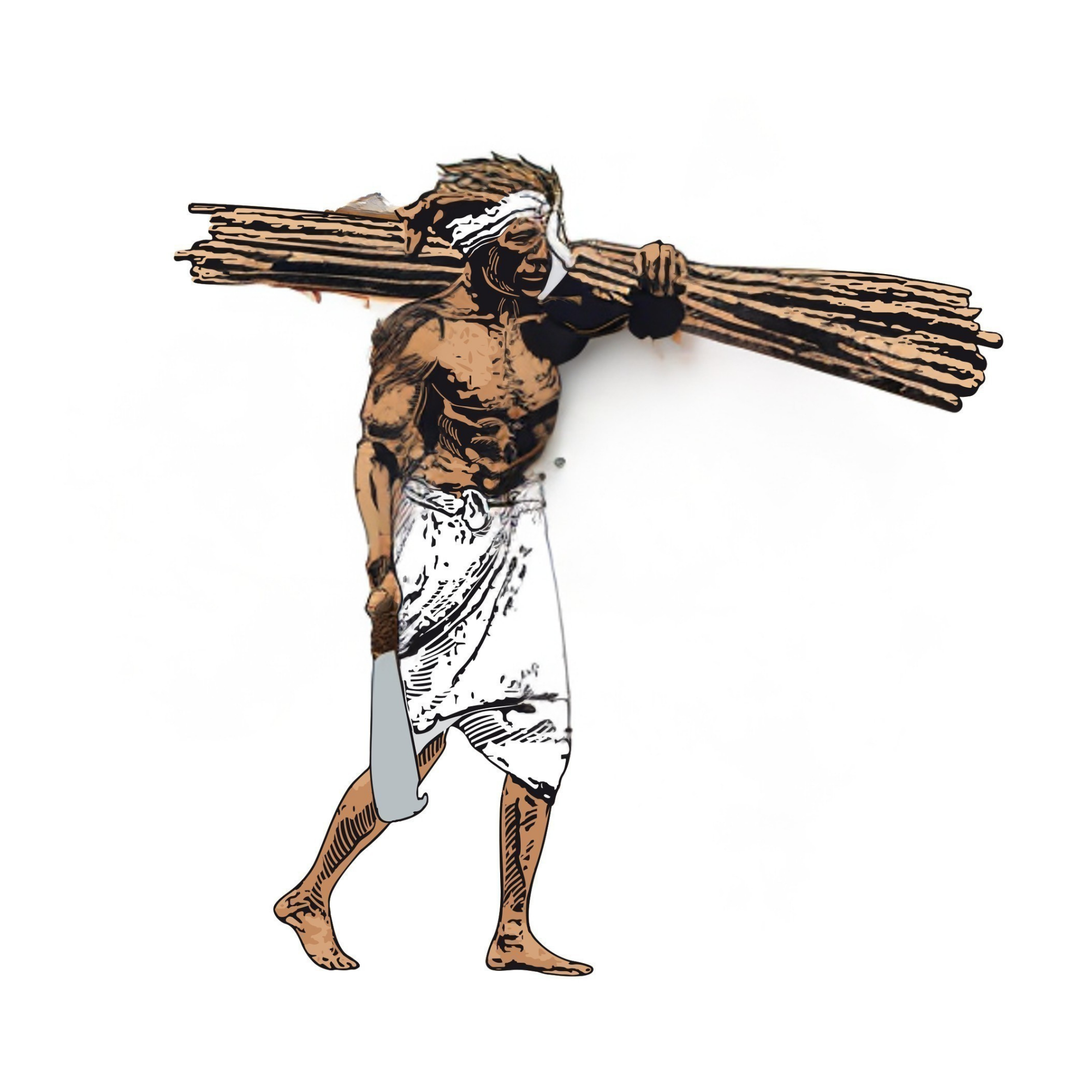
One of the earliest recorded Indian arrivals in Southern Africa dates to 1652, in the Cape Colony. The commission to establish a colony as a mid-stop was given to Jan van Riebeeck by the Dutch East India Company on the Company’s trading route, which later became known as the Cape of Good Hope. Serving as a replenishment point, the colony provided fresh water and other staple foods to ships that spent months at sea navigating trade routes between Europe and the East, including India, Ceylon, Java, and other Southeast Asian Countries.
The individuals and small groups of Indians initially brought by the Dutch to fill the servitude duties of the settlers at the newly established colony were either free servants or bonded, contracted labourers, who were later bartered or given away to colonists to become slaves. There were documented cases of Indians, some children under 10 years old, who were simply kidnapped from their native countries and later sold into slavery by Ship Captains.[1]
“In 1706, a Dutch political prisoner, Jacob van der Heiden, was confined in a dungeon in Cape Town with Ari, an Indian slave charged with serious offences. He found that Ari had been kidnapped as a child while playing with other children on the Surat beach. He had been sold from one master to another and had been treated so harshly that he had run away. He joined other fugitive slaves and lived on stolen food until he was caught. He escaped torture and persecution because of the intercession of the Dutchman.” [2]
The Indian lineage from early slavery can now be traced into modern-day white and coloured ancestry of South Africans, with Ex-President F.W. De Klerk clearly citing his Indian ancestry from the 1600 to 1700s.[3] Other personalities include Catherine of Bengal and Domingo Elvingh, both Indians from Bengal who carried European names and married white men in the Cape colony due to the lack of European women over that period of time.[4] There is evidence that supports Indian traders made contact with Southern Africa prior to 1652 along the east coast of South Africa.[5]
With the establishment of the British Colony of Port Natal in 1843, the growing demand for cheap labour became necessary to drive the economy, especially on sugar plantations, the railway services and in local municipalities. The changing laws in Europe on slavery led the British plantation owners to devise new ways to acquire cheap labour, with some referring to it as a bond contract, but seen as contractual entrapment for Indentured labourers whose lifestyle emulated slavery.
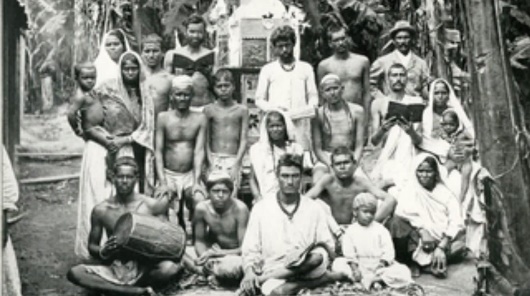
In 1860, with slavery abolished and India still part of the British Empire, the first Indian migrants were ferried their way to the new colony of South Africa under contractual agreement. The bonded period would last for 30 years, and labourers would pay off their travel expenses by means of working the duration of the contractual period. Dissatisfied labourers didn’t have the option to terminate their services to return home due to the high travel expenses due to his employer for themselves and their family, or the option to purchase new tickets for their return trip home. This, coupled with inhumane working and living conditions, fortifies the concept of contractually entrapment and led to high levels of documented suicide amongst labourers on plantations. While some question the conditions of the contract being very closely associated with slavery, one has to question by whose definition a slave is determined, whether it is the victim or the authoritarian. The life of the Indentured labourer and slave was no different; the living and working conditions remained the same, torture and persecution persisted. Slavery was replaced by indentured labour, ownership replaced by contractual entrapment, shackles replaced by debt. Anyone who doesn’t enjoy free will can be considered a slave. Modern society lacks clarity on the true status of the 1860 migrants, whether they were Indentured labourers or slaves. The subject needs to be further researched, and scholars need to correct the historical past if findings prove to be contrary to the current documented history.
A small group of free migrant traders followed to meet the unique demands of the Indian community in the late 1800s and until the 1900s. The Indian trading community was subjected to discrimination in the Port of Natal under British authority, and immigrated inland into the Transvaal, where they were subjected to further discrimination. Boer restrictions prevented them from settling in the Orange Free State. These traders were later to support the Boers financially against the British during the Anglo-Boer War of 1899 to 1902.
In overview, the Indian community has since evolved culturally in South Africa into its own unique identity that cannot be found anywhere across the world. The descendants of the Indian Indentured labourer have contributed significantly to the development of the South African economy and excellence in all spheres of society. The representation of the South African Indian can be found at various levels both in government and in the private sector, with members excelling in the field of politics, medicine, law, arts and culture, etc.
BIBLIOGRAPHY
[1] https://www.sahistory.org.za/sites/default/files/archive-files/india_and_south_africa_by_e.s._reddy.pdf
2 https://www.sahistory.org.za/sites/default/files/archive-files/india_and_south_africa_by_e.s._reddy.pdf
3 https://en.wikipedia.org/wiki/F._W._de_Klerk#:~:text=De%20Klerk%20noted%20that%20he,upbringing%20was%20secure%20and%20comfortable.
4 https://www.sahistory.org.za/sites/default/files/archive-files/india_and_south_africa_by_e.s._reddy.pdf
5 http://www.krugerpark.co.za/africa_indians.html